
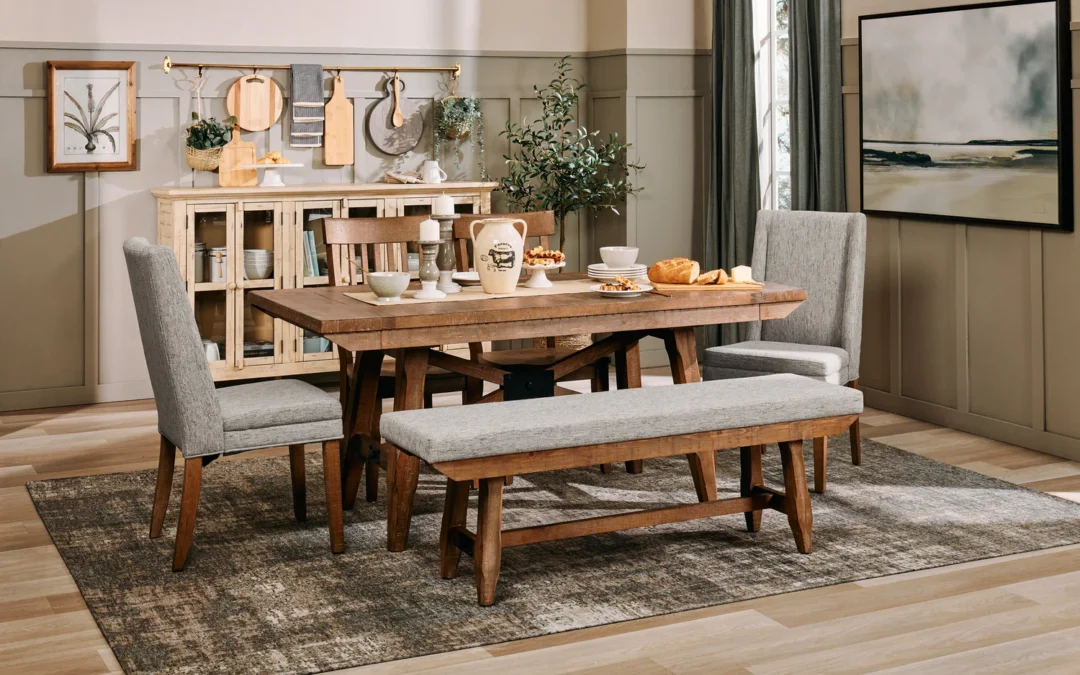
Seating choice determines how a dining area actually functions. Tables rarely fail on their own. Seating does—either by limiting capacity, blocking movement, or creating clutter around the perimeter. The decision is not stylistic. It is structural: benches increase density and flexibility; chairs fix spacing and access.
At TN Farmhouse Furniture, both are built from solid oak, maple, or pine in Clinton, Tennessee and shipped fully assembled nationwide. The correct selection depends on room constraints and use patterns.
Capacity: fixed vs flexible
Chairs create fixed positions. Each seat occupies a defined width and requires clearance on all sides.
Benches compress spacing. Multiple people share a single run, allowing:
- higher seat count along the same table edge
- variable spacing based on group size
- use on one or both sides depending on need
For large gatherings, benches raise capacity without expanding the table footprint.
Browse dining benches:
https://www.tnfarmhousefurniture.com/product-category/benches/
Browse dining tables:
https://www.tnfarmhousefurniture.com/product-category/dining-tables/
FAQ
Which seating fits more people at a table?
Benches. They compress spacing and allow variable seat positions.
Access and movement
Chairs provide individual access. Each seat pulls out independently. This benefits:
- formal seating arrangements
- frequent in-and-out movement
- individual place settings
Benches require shared access. Entry and exit depend on adjacent occupants. This works when:
- seating turnover is low during the meal
- groups sit together for longer periods
- space is limited and movement paths must stay clear
The trade-off is access versus density.
Space efficiency
Room size dictates the baseline choice.
Chairs
- require clearance behind each seat
- increase visual and physical footprint
- create consistent spacing around the table
Benches
- tuck fully under the table when not in use
- reduce perimeter clutter
- open the room during non-meal hours
For tight layouts, benches remove obstruction without changing the table size.
FAQ
What works best in a small dining room?
Benches. They tuck under the table and reduce the footprint.
Stability and load
Seating must handle repeated load cycles: sitting, shifting, leaning.
Solid wood construction provides:
- consistent structural support
- resistance to joint loosening
- long-term alignment under use
Both benches and chairs perform equally when built from solid wood. Failure differences appear in low-quality materials, not in the seating type.
Visual impact and layout control
Chairs define edges. They create a perimeter that visually outlines the table.
Benches reduce visual segmentation. Long runs simplify the layout and keep sightlines open.
Use cases:
- Chairs for defined, formal arrangements
- Benches for open, continuous layouts
Mixing both often resolves the conflict.
Hybrid setups (bench + chairs)
Most functional layouts combine both:
- bench on one side
- chairs on the opposite side and ends
This provides:
- increased capacity
- independent access where needed
- reduced footprint on one side
Hybrid setups work across most room sizes without forcing a single compromise.
FAQ
Can you mix benches and chairs?
Yes. One side bench with chairs on the opposite side balances access and capacity.
Sizing rules for both options
Bench length
- match table length or sit slightly shorter
- allow end clearance for entry
Chair spacing
- allocate consistent width per seat
- maintain clearance behind each chair
Table clearance
- maintain ~36 inches around the table for movement
Correct sizing prevents collisions and access issues.
Material and finish considerations
Dining seating sees continuous contact: weight, movement, and cleaning.
Solid wood provides:
- durability under repeated use
- resistance to surface wear
- stable joints over time
Finishes should allow:
- easy cleaning
- visible grain retention
- minimal marking under normal use
Options include light, mid, dark, and two-tone finishes depending on room balance.
Real use pattern comparison
High-traffic, frequent turnover (family meals, daily use)
- chairs provide faster access
Large gatherings, extended seating (holidays, events)
- benches increase capacity
Limited space with variable use
- hybrid configuration performs best
Seating should match how the table is used, not how it is staged.
Delivery and readiness
Seating must be usable immediately.
Required state:
- fully assembled
- structurally aligned
- ready for placement
All benches and chairs are delivered in that condition.
FAQ
Do benches and chairs ship assembled?
Yes. Delivered fully assembled and ready to use.
Showroom or direct ship
TN Farmhouse Furniture
732 S Charles G Seivers Blvd
Clinton, TN 37716
(800) 677-1058
Nationwide shipping available. All items arrive assembled.