
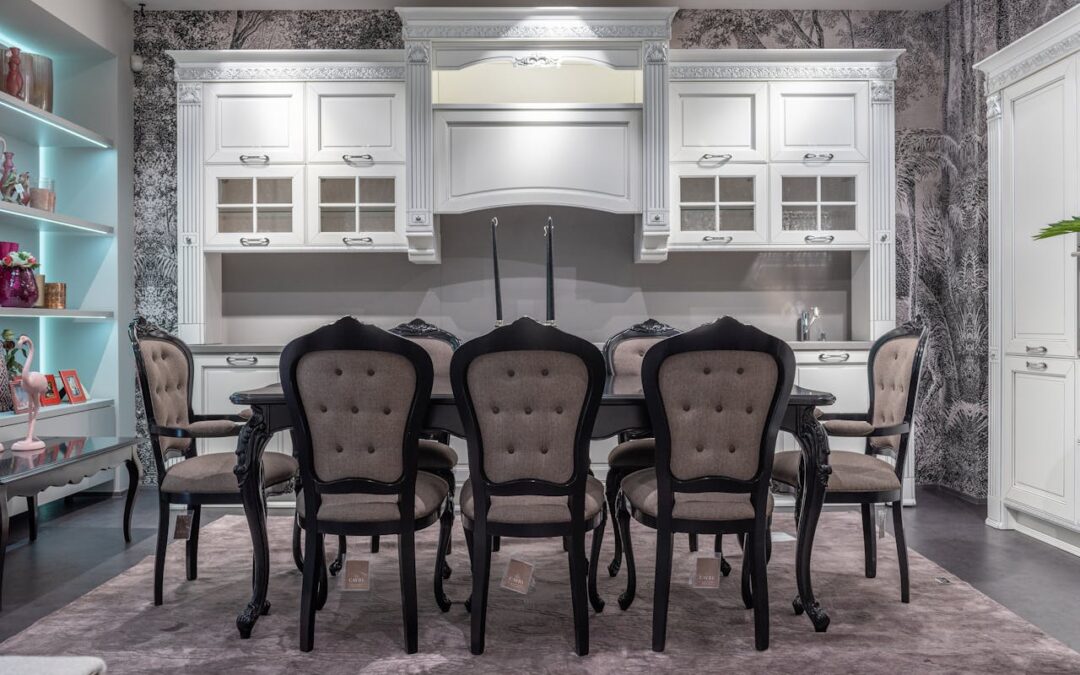
Most dining table regret has nothing to do with finish or wood species. It comes down to one question nobody asked early enough: how many people actually sit at this table on a normal Tuesday, versus Thanksgiving? Those are usually two very different numbers, and the table has to serve both.
The Two Numbers That Matter
Before choosing a size, write down two counts:
- Everyday seating — the number of people who eat at this table on a typical week.
- Peak seating — the largest group you realistically host a few times a year.
If those two numbers are close, a fixed-size table is the simpler, sturdier choice. If peak seating is significantly higher than everyday seating — a family of four that hosts twelve for the holidays — that gap is exactly what an expandable table is built to solve.
The Case for a Fixed-Size Table
A fixed-size table has one fewer mechanism to engineer, which generally means a heavier, more stable build for its size. There’s no leaf to store, no seam to keep level, and no extra hardware to maintain over the years. For a household where the guest count rarely swings far from the everyday number, a fixed table sized correctly for the room is usually the better long-term piece — simpler joinery, one continuous top, and nothing to line up before a dinner party.
A well-sized fixed table also tends to anchor a room better visually. An expandable table, even closed, sometimes reads as “collapsed” rather than “complete” — a tradeoff worth knowing before you choose one purely for flexibility you may only use twice a year.
The Case for an Expandable Table
If your peak seating regularly outpaces your everyday number, sizing the table for the big gathering means living with a table that’s oversized the other 350 days of the year. That’s the problem an expandable table solves — it can sit at a comfortable everyday footprint and grow when the extra leaf goes in.
The tradeoff is mechanical. An expandable table has a seam, hardware that needs to stay aligned, and a leaf that needs somewhere to live when it’s not in use. None of that is a dealbreaker on a well-built custom piece — it’s simply a maintenance consideration a fixed table doesn’t have.
A Middle Option: Build for Peak, Add Flexible Seating
There’s a third path worth considering before committing to expandability: size the table itself for everyday use, and handle occasional overflow with a bench on one side instead of chairs. A bench seats more people per linear foot than chairs and can flex from three people to four without anyone needing to pull up an extra seat — often enough to absorb the gap between everyday and peak seating without an expansion mechanism at all.
Matching the Table to the Room, Either Way
Whichever direction you go, the room still sets the ceiling on size. As a general guide:
- Smaller dining spaces typically suit a table in the 5–6 foot range, comfortably seating four to six.
- Larger dining rooms can support a 6–8 foot table, seating six to eight.
- Great rooms or open-concept spaces can go well beyond that — the 16 ft dining/conference table shows how far a single custom trestle build can be scaled when the room allows it.
Leave at least 36 inches of clearance behind every chair so people can push back and stand without bumping a wall or hutch — that clearance number, not the tabletop size alone, is usually what actually constrains a dining room.
What to Decide Before You Order
- Everyday seating count vs. peak seating count
- Whether you’d rather store a leaf occasionally or keep the table at one fixed size
- Table shape — rectangular tables scale more easily than round ones
- Wood species and finish, and whether it should match existing furniture in the room
Because every table here is custom built rather than pulled from a factory catalog, this is a conversation to have directly with the builder — sizing, shape and whether a leaf makes sense for your specific table are all decided together, not picked from a preset list.
Built for How You Actually Use It
A dining table succeeds or fails on fit, not just finish. Whether that means a fixed table sized precisely for your room or a table designed with room to grow, it’s worth starting from how your household actually eats, not just how it entertains twice a year.
Read more on choosing a farmhouse dining table and our solid wood dining table options, browse the dining collection, or contact us with your room dimensions to start a custom build. Call (800) 677-1058.